Screw Compressor Will Not Load or Unload: Causes and Solutions
A screw compressor that runs without producing air, or fails to unload at the upper pressure setpoint, may have a solenoid valve, inlet valve, control-air line, pressure sensor or minimum-pressure valve fault. Stop immediately if the safety valve operates.
· BOSAN
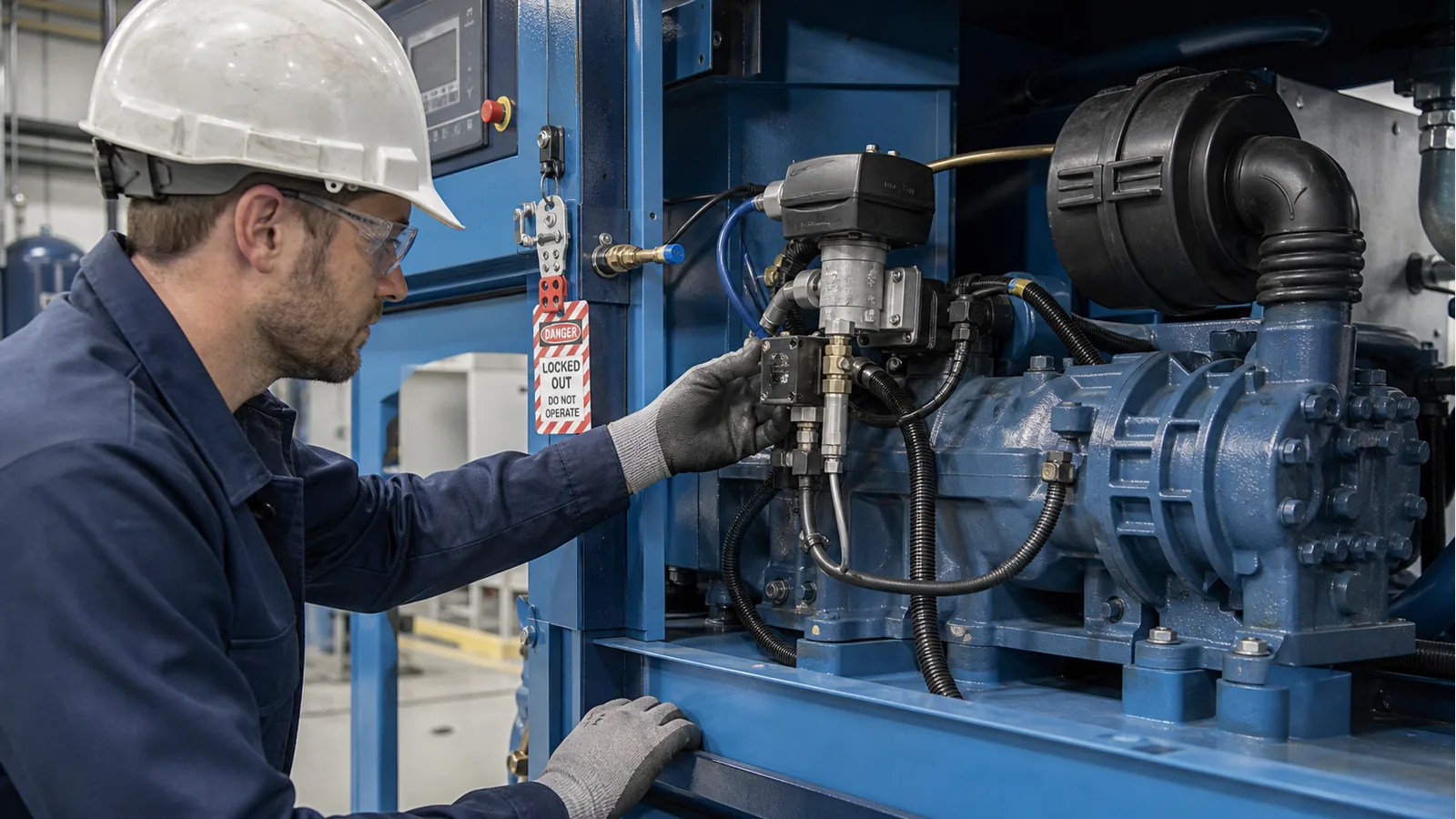
During loading the inlet valve opens and the compressor produces air; during unloading it closes and internal pressure is released as designed. First confirm that the controller issued the command, then inspect the actuator. Never adjust the safety valve or disconnect control tubing to force a test.
Typical Symptoms
- The motor runs but system pressure does not rise; the controller indicates loaded while the inlet valve remains closed.
- Pressure continues rising after the unload setpoint, causing safety-valve discharge or a high-pressure shutdown.
- Load and unload response is slow, the inlet valve sticks, or control air leaks continuously.
- Internal pressure does not fall during unloading, causing a heavy restart or harsh reload transition.
Diagnostic Sequence
- Confirm that actual pressure agrees with the controller and verify load, unload and stop setpoints.
- Observe controller output status and determine whether the load solenoid receives an electrical command. Electrical measurement must be performed by qualified personnel.
- After isolation and depressurization, inspect the solenoid coil, spool, silencer and control-air tubing for restriction, leakage or incorrect connection.
- Inspect the inlet valve for deposits, sticking, damaged diaphragm/piston or return-spring failure.
- For failure to load, check severe minimum-pressure-valve leakage, availability of control pressure and whether the blowdown valve remains open.
- For failure to unload, check that the inlet valve closes fully, the blowdown circuit opens and the pressure sensor is not reading low.
- Inspect check-valve leakage and downstream pressure backflow. Treat any safety-valve operation as a pressure-control failure and stop immediately.
Corrective Actions
- Repair or replace the faulty solenoid valve, control-air tubing, inlet-valve seals and actuator.
- Calibrate the pressure sensor and restore correct load/unload setpoints without exceeding nameplate pressure.
- Service the minimum-pressure valve, blowdown valve and check valve; confirm that internal pressure falls correctly during unload.
- After repair, test valve operation unloaded before gradually loading and observing pressure and protective functions.
Stop the Compressor and Call a Qualified Technician When
- The safety valve operates, pressure exceeds the permitted range or continues rising.
- The inlet or minimum-pressure valve must be dismantled in a pressure-containing section.
- A solenoid coil is burnt, control wiring is shorted or a valve has mechanically fractured.
Prevention
- Inspect control-air tubes, fittings and solenoid silencers regularly.
- Maintain inlet filtration and lubricant condition to reduce inlet-valve dirt and varnish.
- Calibrate pressure sensors and test safety valves at intervals required by regulation and the manufacturer.
- Record normal loading, unloading and blowdown times.
Important Note
A safety valve is the final protective device, not a pressure regulator. Never tighten it, bypass a pressure switch or raise the controller pressure limit to conceal an unloading fault.