Air Compressor Will Not Start or Keeps Stopping: Troubleshooting Guide
When an air compressor will not start or stops unexpectedly, read the alarm history first, then check emergency-stop status, power, phase sequence, overload, temperature, system pressure, remote interlocks and drive status. Do not force repeated starts.
· BOSAN
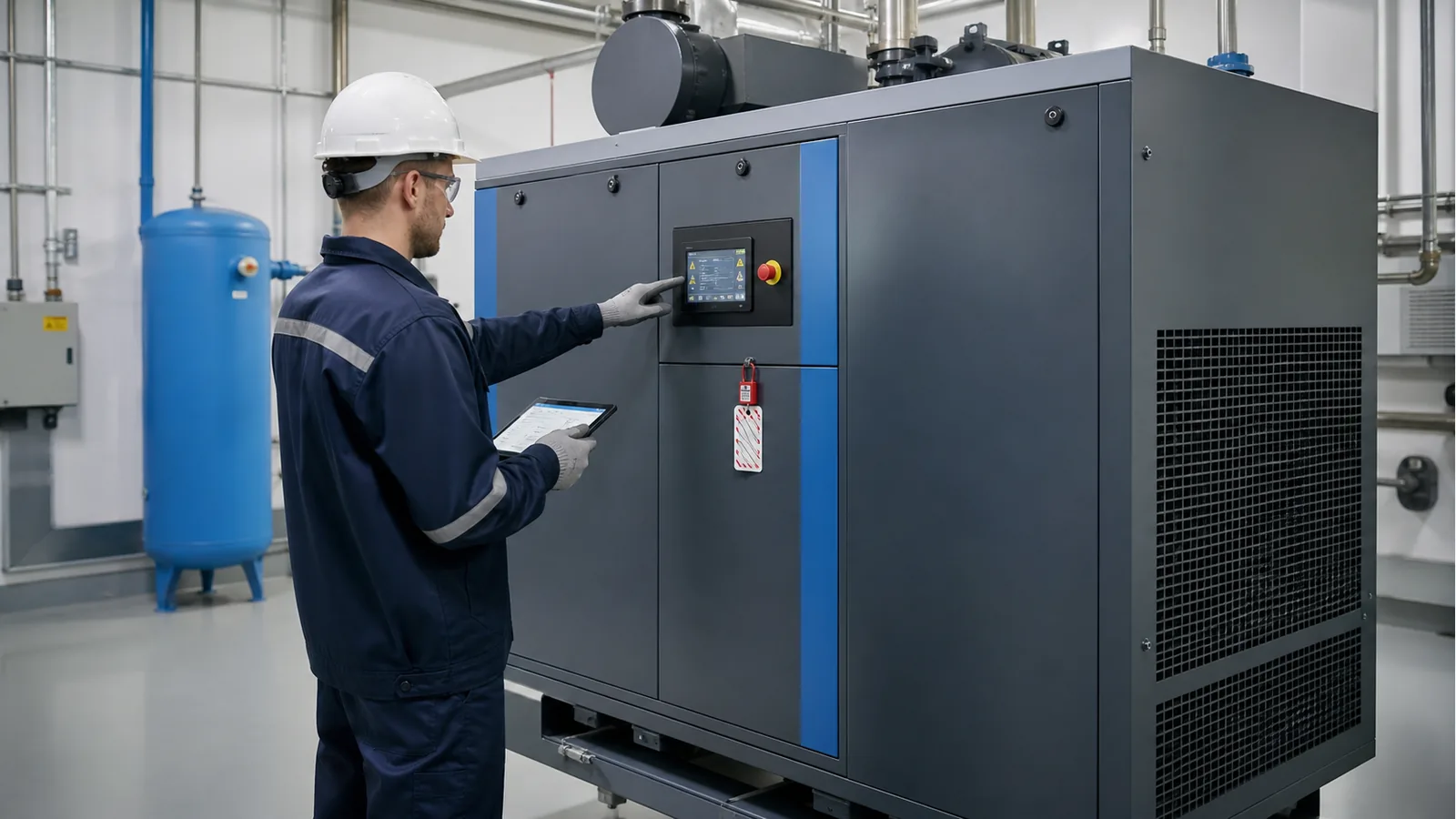
A failed start may be a correct protective response rather than a defective starter. High system pressure, a remote stop signal or a maintenance interlock can prevent motor operation. Preserve the event history before removing power or clearing alarms.
Typical Symptoms
- The start button has no effect and the controller shows standby, start inhibited or an unsatisfied interlock.
- The contactor closes but the motor does not rotate, or the breaker or overload trips immediately.
- The unit stops during operation without operator input and shows a temperature, voltage or sensor fault after power is restored.
- The compressor repeatedly stops and restarts or can run only unloaded.
Diagnostic Sequence
- Photograph the active alarm, event history, shutdown cause and running hours before clearing any controller information.
- Confirm that the emergency stop is released, guards and remote interlocks are satisfied, the operating mode is correct, and no timer or supervisory controller is commanding stop.
- Check whether system pressure is above the start or load threshold. Some machines correctly wait for pressure to fall before starting.
- A licensed electrician should check main and control power, fuses, breakers, phase-sequence relay, contactors and motor-overload status.
- Determine whether high temperature, low temperature, lubricant-level, pressure-sensor, fan or drive faults remain active. Do not force a start while the protective condition remains.
- After isolation and depressurization, follow the manual to confirm that the air end and drive can rotate and that there is no seizure, liquid accumulation or excessive mechanical resistance.
- On VSD units, read the drive code and check STO safety inputs, communication, DC-bus and motor-feedback status.
Corrective Actions
- Restore emergency-stop, guard-switch, remote-interlock and control-mode conditions and confirm operator authorization.
- After correcting supply, phase sequence, control fuse, contactor or overload issues, perform one controlled unloaded start.
- Correct the root cause of temperature, sensing, lubrication or mechanical binding before resetting the alarm.
- If the event history does not identify the cause, export controller data and contact a technician familiar with the model.
Stop the Compressor and Call a Qualified Technician When
- The breaker trips immediately, arcing occurs, or the motor hums without rotating.
- The air end cannot be turned, liquid has entered the element, the coupling is damaged or metallic impact is present.
- The same protection repeats or starting would require bypassing a safety interlock.
Prevention
- Back up controller parameters and alarm history regularly.
- Record shutdown causes at shift handover and avoid removing main power before fault information is captured.
- Function-test emergency stops, guard switches, phase monitoring and remote interlocks.
- Follow the manufacturer's preservation and recommissioning procedure after a long shutdown.
Important Note
Automatic standby, delayed start and pressure-satisfied stop may be normal control functions. Understand the model's start-permission conditions and operating mode before diagnosing a fault.