Air Compressor Motor Overload or High Current: Troubleshooting Steps
Do not treat a motor-overload alarm by repeatedly resetting the overload relay. Check three-phase voltage and current, discharge pressure, inlet and separator restrictions, air-end rotation, lubrication, contactors and motor insulation to identify the electrical or mechanical load.
· BOSAN
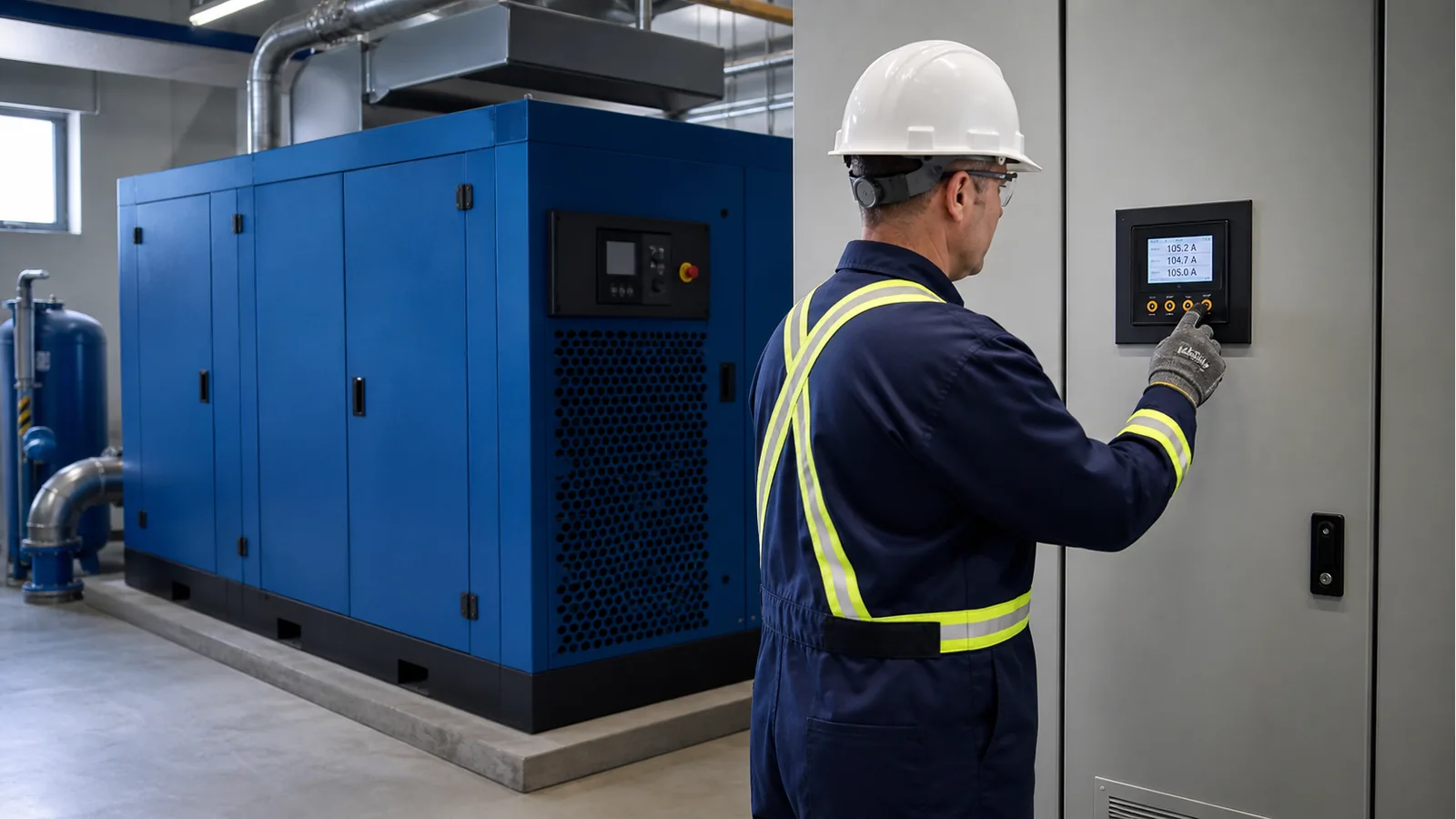
Overload protection prevents the motor and cables from continuing to heat during overcurrent, phase loss or mechanical seizure. Resetting without diagnosis can turn a correctable filter restriction or bad connection into motor, drive or air-end damage.
Typical Symptoms
- The unit trips immediately during starting, trips after loading, or operates for a period before the thermal overload opens.
- The controller reports main-motor overload, overcurrent, stall or excessive motor temperature.
- Phase currents are unbalanced, the motor hums or overheats, or contactors and cables become hot.
- Discharge pressure or separator differential pressure is high, or the air end produces a heavy rubbing sound.
Diagnostic Sequence
- Record whether the event occurs during starting, loading, full load or deceleration, together with pressure, frequency, ambient temperature and current.
- A licensed electrician should compare the motor nameplate, overload setting and controller parameters, then measure three-phase voltage and current. Check phase loss, imbalance and voltage drop across contactor poles.
- Confirm that discharge pressure, unload pressure and system back pressure do not exceed the model limits. Compare the pressure transducer with a calibrated gauge.
- Check differential pressure across the inlet filter, inlet valve, oil filter and air/oil separator. Restriction can increase air-end load or cause incorrect control.
- After shutdown and depressurization, follow the manual to verify that the air end, coupling or belt drive rotates freely. Inspect bearings, belt tension, alignment and foreign-object interference.
- Verify lubricant type, level, condition and circulation. Insufficient lubrication, unsuitable viscosity or cold starting can increase torque demand.
- On VSD units, read the drive fault history and verify motor data, acceleration/deceleration time, minimum speed and cooling. Insulation and winding tests may be required.
Corrective Actions
- Correct phase loss, voltage imbalance, poor contacts and incorrect overload settings, but never raise a setting beyond the motor and package limits.
- Restore correct pressure settings; replace filters that have reached differential-pressure or service-life limits; repair an inlet valve that cannot fully open and a control circuit that cannot unload correctly.
- Repair coupling, belt, bearing or air-end binding. Confirm free rotation and correct lubrication before energizing the unit.
- After one controlled reset, monitor all phase currents unloaded and loaded. If the alarm repeats, stop resetting and perform professional diagnosis.
Stop the Compressor and Call a Qualified Technician When
- The motor, contactor or cable produces smoke, a burnt smell, abnormal heat or insulation-test failure.
- The air end does not rotate freely, metallic impact is heard, or current rises rapidly.
- The same overload returns after reset or phase current remains seriously unbalanced.
Prevention
- Trend full-load phase current, discharge pressure and separator differential pressure.
- Service inlet, oil and separator filters according to actual environmental conditions.
- Periodically torque power terminals and perform thermographic and motor-insulation checks.
- Use the specified heating and warm-up procedure in cold environments to avoid starting with high-viscosity lubricant.
Important Note
The overload relay, variable-speed drive and motor thermistor may report separate faults. Identify the protection source first and use the package wiring diagram and drive manual for diagnosis.